The reconstitution liquid, bioengineered per peptide — not the water everyone takes for granted.
For decades, reconstitution has been an afterthought. Reach for a vial of bacteriostatic water, add it, swirl, inject. One generic solvent, poured onto molecules that are anything but generic — and the assumption that dissolved means done.
Bacteriostatic water does its labelled job. It is an accepted diluent — approved products ship it as their reconstitution companion — and for robust molecules, small volumes and prompt use, that job is real.[L2] But read its own label the way a formulator reads it, and the label indicts itself. This is what the bottle actually is, in its own words:[L1]
"…a sterile, nonpyrogenic preparation of water for injection containing 0.9% (9 mg/mL)… of benzyl alcohol added as a bacteriostatic preservative." Water, plus a preservative to keep a multi-dose vial usable across repeated withdrawals. That is the whole recipe.
"The pH is 5.7 (4.5 to 7.0)." An unbuffered liquid — one nominal number inside a wide acceptance window, and no pH strategy for the molecule it is about to meet.
"…must be made approximately isotonic prior to use." Hypotonic as supplied: tonicity is not included in the bottle. Making it is left to whoever holds the vial.
"WARNING: NOT FOR USE IN NEONATES." The label's own caution about its preservative.
— Bacteriostatic Water for Injection, USP (Hospira), FDA/DailyMed label [L1 · evidence ↓]
No pH strategy. No chelation. No oxygen control, no gas control, no anti-gelation. It treats a delicate, chemically specific peptide exactly the same as any other. A generic diluent is a floor — and the gap between that floor and what the molecule actually needs is what P-EARLs was built to close.
The instant a peptide re-enters solution, the liquid's chemistry sets its fate. Not later — immediately, and irreversibly for that dose. Four decisions happen at once, and a generic diluent makes none of them on purpose.
Banal water asks every peptide to be average. Not every peptide is — and the exceptional ones lose the most.
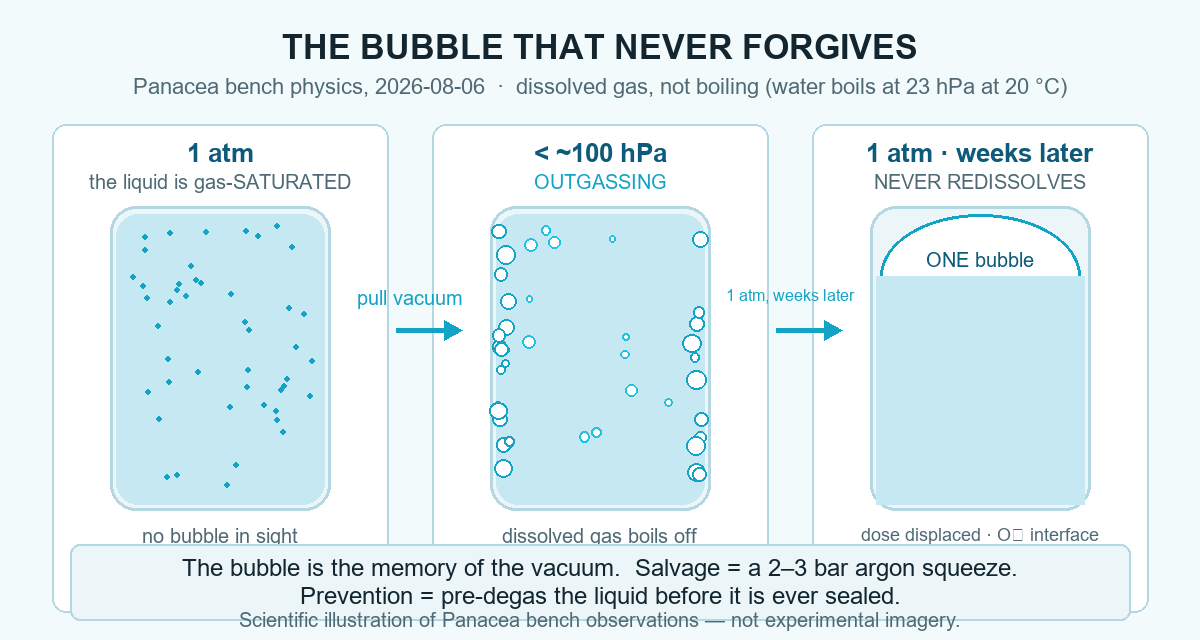
On 6 August 2026, on the Panacea bench, a P-EARL chamber taught us something no datasheet ever had. Pull the vacuum down past roughly 100 hPa and the liquid bubbles — not boiling (water boils far deeper, at 23 hPa at 20 °C), but dissolved gas coming out of solution, nucleating on every wall. Everywhere except the plungers.
Then came the finding that rewrote the doctrine: the bubbles never redissolve. Bring the chamber back to atmosphere and wait — days, weeks. The bubbles do not shrink back into solution; they drift together and coalesce into one permanent bubble. The liquid had been gas-saturated at 1 atm all along. The bubble is the memory of the vacuum.
A permanent bubble is not cosmetic. It displaces dose volume, it adds a compressible compartment where there should be incompressible liquid, and it parks a standing oxygen interface against the peptide. Once it exists, patience does nothing — the rescue is pressure, not patience: a 2–3 bar argon squeeze drives the gas back into solution.
And the counterfactual that makes the cartridge elegant: outside the chamber, vacuum never reaches the liquid at all. The floating pistons keep it riding at 1 atm even under deep needle-only vacuum — it never bubbles. Glycerol, already inside for lubricity and optical shine, did not prevent outgassing — the elegant additive alibi died on the bench. Degassing even improves the shine.
The consequence is doctrine: every P-EARL is pre-degassed before it is ever sealed — oxygen-starved, argon-conditioned, bubble-free from birth.
P-EARLs — Panacea-Engineered Aseptic Reconstitution Liquids. Not a diluent: a family of bespoke liquids, each tuned to the peptide it wakes — acidic, basic, amphiphilic or degradation-prone, each peptide gets a precision-paired liquid that keeps it folded, soluble, unoxidised and fully potent, then delivers it bubble-free. Aseptically produced, tonicity engineered for the delivered dose, protected by architecture rather than by a universal bacteriostatic additive. We do not believe in "one solvent fits all"; we believe in molecular matching. Purity comes first — even where that means a slightly longer, gentler dissolution.


Dicoias Ψ™ reads the substance before the bench does. Its substance-intelligence vectors rank excipients and vehicles against the peptide's own chemistry and score every candidate liquid — P-EARL Fit, 0–100 — with the certainty deliberately capped, so a number never pretends to know more than the evidence behind it. Only then does Peptourbillon™ compute the recipe: buffer, chelation, tonicity. The liquid is prescribed per molecule, not per habit.
The best reconstitution liquid on this planet — because it is what Panacea says it is.
A P-EARL is computed, not poured. Peptourbillon™ and Dicoias Ψ™ turn the peptide's chemistry into a tiered recipe — and sometimes the recipe says no.
Buffer and tonicity engineered for the delivered dose. For robust molecules this is the whole answer — engineered, not generic.
Adds aggregation control — arginine, for example — and chelation only where the sequence calls for it. Conditional, never automatic.
For the sequences that gel at the wetting front: anti-gelation and crowding agents. Here citrate serves as chelation, not as the buffer.
Chelation is withheld where the metal is the point. GHK-Cu carries a copper ion it cannot function without; stripping trace metals would strip the peptide itself. A P-EARL never takes what a peptide needs.
The pI trap — a true story with arithmetic. Retatrutide's isoelectric point sits at pI 4.0. Reconstituted with plain bacteriostatic water — unbuffered, nominal pH 5.7 — the final solution lands near pH 6.8, uncomfortably close to the low-solubility region, and the cake dissolves slowly and reluctantly. The engineered P-EARL for the same peptide pairs two phosphate species against pKa2 7.21 and holds the final liquid at pH 7.40 — by Henderson–Hasselbalch arithmetic, not by hope. Two pHs, one truth: the final liquid is the only liquid that matters.
One bench observation became law. On 22 May 2026 a polysorbate-containing trial liquid bubbled under the vacuum cycles of the VANA (Vacuum–Argon–Nitrogen Architecture) — and from that day, no polysorbate ever enters a P-EARL. It is a hard engine law, not a preference: the formulation engine refuses a polysorbate recipe outright. (Polysorbate 20 may still serve cake-side, where the physics is different.) The literature independently backs the instinct: polysorbates spontaneously and rapidly auto-oxidize in aqueous solution into protein-damaging peroxides and reactive aldehydes,[13][14] and a surfactant that stops shaking-induced aggregation can still worsen oxidation and aggregation in storage.[15] The industry buys surfactant insurance. Panacea engineers interface protection cake-side — geometry instead of surfactants.
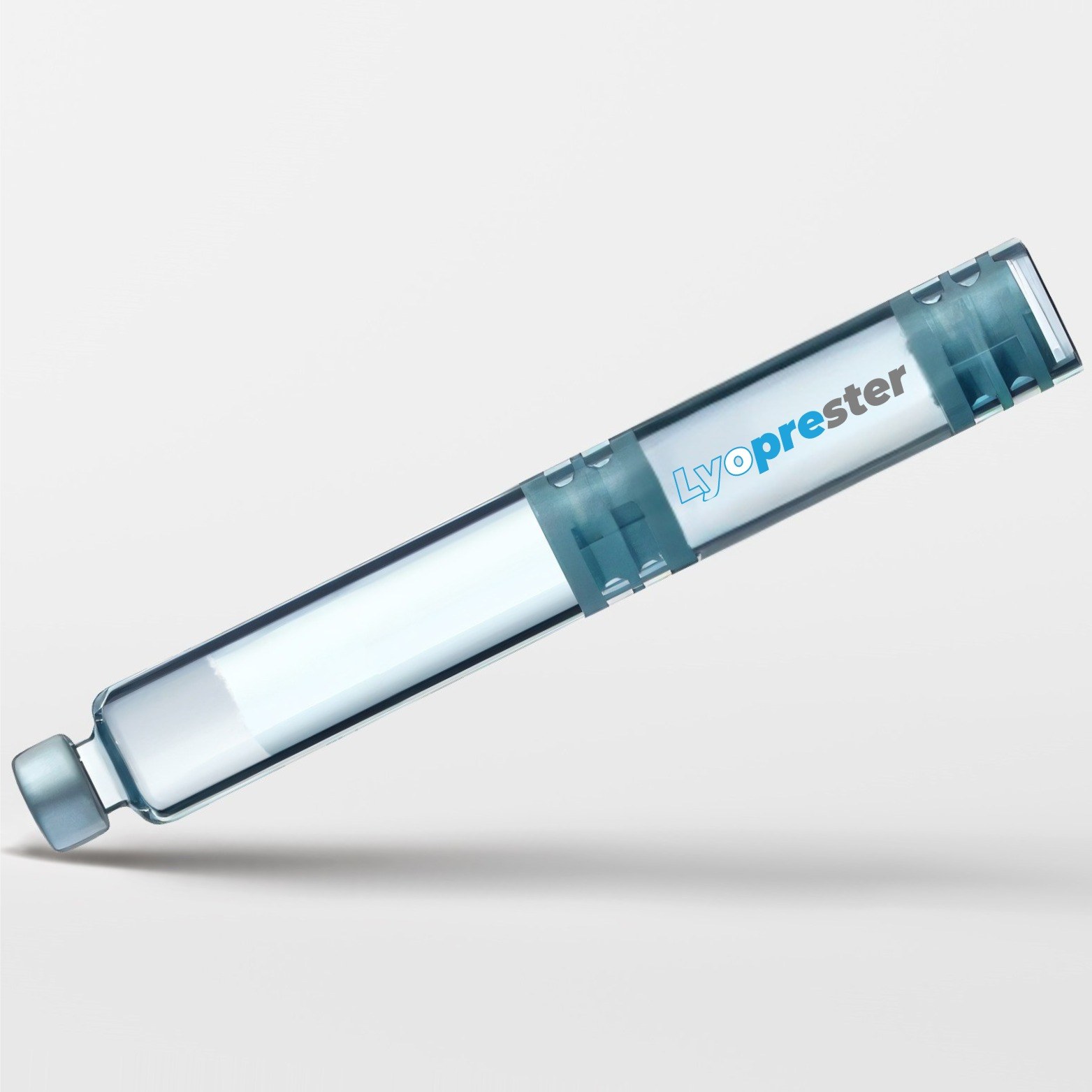
A P-EARL does not sit in a separate vial waiting to be measured. It is preloaded in the second chamber of the Lyoprester® dual-chamber cartridge — the lyophilized peptide cake in one chamber under vacuum with argon fillback, its bespoke P-EARL in the other, completely filled, with no air bubble at all. Two years sealed. One tap draws the liquid through into the cake; the RF Tunnel™ channel carries it to the core, and ElimiVoid™ keeps the whole draw bubble-free. About thirty seconds later the peptide is awake — still sealed. No vial, no manual mixing, no guessing: the right chemistry, in place, at the point of use. It is the format the industry itself reaches for when the reconstitution moment matters — cake and diluent kept apart until use.[16]
Every scientific claim on this page traces to a primary source — the FDA/DailyMed label of the diluent itself, and peer-reviewed formulation science. The bench findings in the bubble chapter are Panacea's own measurements, taken on Panacea hardware. Concept: Bogdan Dicoias, biochemist and inventor. Published by Panacea Bio Chem Scientific Communications. Last evidence search: 15 August 2026.
What is P-EARL?
P-EARL stands for Panacea-Engineered Aseptic Reconstitution Liquid — Panacea Bio Chem's bespoke reconstitution liquid, engineered to a specific peptide's chemistry rather than the one-size-fits-all bacteriostatic water most reconstitution relies on. Buffered to the peptide's optimal pH, oxygen-depleted, argon-dissolved and bubble-free, it is preloaded in the second chamber of the Lyoprester® dual-chamber cartridge: one tap, about thirty seconds, still sealed.
Why not just use bacteriostatic water for everything?
Because its own FDA label says what it is: water with 0.9% benzyl alcohol as a bacteriostatic preservative, unbuffered (nominal pH 5.7, anywhere in a 4.5–7.0 acceptance range), and hypotonic as supplied — it “must be made approximately isotonic prior to use”. The moment a peptide dissolves, the liquid's pH, dissolved oxygen, trace metals and tonicity decide its charge, its binding-competent conformation, its aggregation and its oxidation. A generic diluent makes none of those decisions on purpose.
Bacteriostatic water vs P-EARLs — what is the difference?
Bacteriostatic water is a floor: an accepted generic diluent that keeps a multi-dose vial usable across repeated withdrawals. A P-EARL is the engineered ceiling: a liquid computed per peptide — buffer chosen by Henderson–Hasselbalch arithmetic, dissolved oxygen stripped, trace metals controlled, argon dissolved in, bubbles excluded — and delivered inside the cartridge instead of a separate vial.
Is bacteriostatic water enough for peptides?
For robust molecules, small volumes and prompt use, it does its labelled job — approved products ship it as their reconstitution diluent. The risk is molecule-specific: it concentrates in aggregation-prone peptides, a landing pH near the isoelectric region, warm storage and long holds after reconstitution. A P-EARL removes the guesswork by engineering those variables for the specific peptide.
Does benzyl alcohol really aggregate proteins?
In the published record, under the right conditions, yes: 0.9% benzyl alcohol — exactly the bacteriostatic-water concentration — accelerated aggregation and precipitation of a therapeutic protein in aqueous solution, and reconstituting a lyophilized protein with benzyl-alcohol water fostered aggregation at the very moment of reconstitution. The effect depends on the molecule, the pH and the temperature — which is exactly why a liquid engineered per peptide outperforms a generic one.
What is bubble-free reconstitution, and why do bubbles matter?
Panacea bench physics (6 August 2026): below ~100 hPa a reconstitution liquid outgasses its dissolved gas — and the bubbles never redissolve. Weeks at atmosphere later they have coalesced into one permanent bubble that displaces dose volume, adds a compressible pocket and parks a standing oxygen interface against the peptide. P-EARLs are pre-degassed and argon-conditioned before sealing, and ElimiVoid™ keeps the draw bubble-free, so the bubble never forms in the first place.
What technologies are inside a P-EARL?
A protection stack, dissolved into one liquid: OxyDeplete™ (oxygen depletion), RedoxVault™ (redox and trace-metal protection), ArgonLock™ (argon dissolved into the liquid itself), ElimiVoid™ (void- and bubble-free delivery) and RF Tunnel™ (a central channel so the cake's core and surface dissolve together) — with Peptourbillon™ computing each recipe, Dicoias Ψ™ prescribing it per chemistry, and PleniDose™ filling it into the Lyoprester® cartridge.
What is Dicoias Ψ?
Panacea's substance-intelligence: it reads a peptide's chemistry and ranks excipients and vehicles before the first bench run, scoring each candidate liquid's P-EARL Fit from 0 to 100 — with the certainty deliberately capped, so a score never claims more than the evidence behind it. It is how each bespoke liquid is prescribed per molecule, not per habit.
Recent developments in the field — refreshed 2026-10-09 by Panacea Bio Chem.
The verified primary sources behind this page — FDA/DailyMed labels and peer-reviewed formulation science — are listed in Evidence & references.
The Panacea Technology Universe
Proprietary Panacea Bio Chem Ltd technologies, invented by Bogdan Dicoias — what each one does, and why it leads its class.
Lyoprester®The only dual-chamber cartridge that is autoreconstitution-enabled, vacuum-sealed and argon-fillback.lyoprester.com ↗
P-EARLs™Panacea-Engineered Aseptic Reconstitution Liquid(s) — each tuned to the peptide it wakes.p-earls.com ↗
Peptourbillon™The layered peptide formulation architecture — single- or multi-layer, never a blend.peptourbillon.com ↗
RF Tunnel™The RF-formed central channel through the cake.rftunnel.com ↗
TgShift™Raises the cake’s glass-transition temperature with RF — instead of chilling below it.tgshift.com ↗
Cryolapse™Cryogenic pressure collapse under S3Pulse™ control — vapour redistributed through the whole cake, not its surface, impeding crust formation.cryolapse.com ↗
LyoLevit™The cake levitates and spins in high orbit — driven by ultrasound and RF.lyolevit.com ↗
Lyochrysalis™The integrated chamber housing the whole drying stack.lyochrysalis.com ↗
S3Pulse™The control brain for every piece of Panacea hardware.s3pulse.com ↗
Liquiprester™The single-liquid cartridge engineered so multiple peptide APIs coexist in one shared vehicle.liquiprester.com ↗
Syntheseract™Continuous-flow peptide synthesis in a special, very fast and economical way.syntheseract.com ↗
CFSPPS™Continuous-flow solid-phase peptide synthesis, written as its own category.cfspps.com ↗
OxyDeplete™Degassing plus no-headspace doctrine — the oxygen-starved seal.oxydeplete.com ↗
ArgonLock™The final inert-atmosphere lock under argon.argonlock.com ↗
RedoxVault™Separation, not merely suppression — redox isolation in lipid micro-reservoirs.redoxvault.com ↗
PleniDose™The shared filling gantry — one machine filling both the dual-chamber Lyoprester and the liquid Liquiprester.plenidose.com ↗
IncreSure™The dose-metrology layer — verified API per pen increment.incresure.com ↗
ElimiVoid™Front-void elimination without touching the metered dose.elimivoid.com ↗
Cryoviscous™The characterised cold, high-viscosity, low-mobility conditioning state.cryoviscous.com ↗
Vana Machine™Vacuum–Argon–Nitrogen Architecture — draws the air and nitrogen out of the cake and backfills with argon; in a separate process, the same machine makes the P-EARLs bubble-free.www.vanamachine.com ↗
EZnject™The disposable auto-injector pen built around the Lyoprester.panaceaeznject.com ↗
Dicoias ΨThe computed-chemistry advisory — every substance reduced to a vector across physical, electronic and formulation space.dcppsi.com ↗
SealoPrester™Aseptic Cartridge Closure System — Seal o’ Precision + Sterility.sealoprester.com ↗
Peptidic LiquidThe peptide formulation in solution — the active plus its buffers, cryoprotectants, lyoprotectants and scaffolders.peptidicliquid.com ↗
DiastolVAC™Biomimetic diastolic vacuum control — the pneumatic circulatory system of the machine: pumps, valves and sensors as one ensemble.diastolvac.com ↗The publications indexed in PubMed in the last 30 days for ("bacteriostatic water"[tiab] OR diluent[tiab] OR diluents[tiab] OR "benzyl alcohol"[tiab] OR reconstitution[ti] OR reconstituted[ti] OR "reconstitution solution"[tiab] OR "reconstitution medium"[tiab] OR "reconstituted solution"[tiab] OR "reconstituted solutions"[tiab] OR "after reconstitution"[tiab] OR "upon reconstitution"[tiab] OR "post-reconstitution"[tiab] OR "in-use stability"[tiab] OR "in-use"[tiab]) AND (peptide[tiab] OR peptides[tiab] OR lyophilized[tiab] OR lyophilised[tiab] OR "freeze-dried"[tiab] OR "lyophilized powder"[tiab] OR injectable*[tiab] OR "for injection"[tiab] OR insulin[tiab] OR "growth hormone"[tiab] OR "monoclonal antibody"[tiab] OR "monoclonal antibodies"[tiab] OR "drug product"[tiab]) AND (stability[tiab] OR aggregation[tiab] OR "injection site"[tiab] OR "injection pain"[tiab] OR oxidation[tiab] OR pH[tiab] OR "dissolved oxygen"[tiab] OR osmolality[tiab] OR bubble[tiab] OR bubbles[tiab] OR foaming[tiab] OR preservative[tiab] OR preservatives[tiab] OR "antimicrobial preservative"[tiab] OR "multi-dose"[tiab] OR multidose[tiab] OR "subvisible particles"[tiab] OR "visible particles"[tiab]) NOT ("immune reconstitution"[tiab] OR food[tiab] OR dental[tiab] OR rice[tiab] OR milk[tiab] OR probiotic*[tiab] OR exosome*[tiab] OR bone[ti] OR blood[ti] OR platelet*[tiab] OR cell[ti] OR cells[ti] OR "3D"[tiab] OR vaccine*[ti] OR microcapsule*[tiab] OR synbiotic*[tiab]) already appear in Trending above — the next most recent in the field, refreshed weekly.
Topic watch: The week's newest publications in "P-EARLs" OR "peptide reconstitution liquid" — refreshed weekly.